Friday, 14 June 2013

Alternative Metal - Ennebi Fondale Bronzo


Ever since the PAM 382 was unveiled to the world in 2011, the popularity of watches featuring this alloy have also surged. thus, when I was informed by Gnomon of the availability of the Ennebi Bronzo recently, i fled down to the shop to take a look. Within minutes, I've acquired my first bronze watch.

Ennebi is not a new name in the world of horology. Based on the information I've scoured from the internet, this brand seem to enjoy some kind of cult status among enthusiasts. I've never heard of this maker until I started visiting Gnomon.

"Out of stock" are three words that a synonymous with Ennebi. They are consistently sold out. The wait time for one can stretch from 6 months to a year.


I'm  not certain of the composition or materials used by Ennebi in it's bronze cases. What I do know is I like it enough to purchase one. What I do know, from other owners is that theirs' have patina-ed nicely over time. Unlike the recently released Steinhart Marine Officer Chrono Bronzo, the Ennebi case is not as shiny or bright. The Ennebi Fondale Bronzo has a matte tint that is rather dull looking. The case had already achieved some patina when it arrived at the Gnomon showroom.

The Fondale Bronzo is fitted with a pari of shark skin straps that matches the case like truffle to scrambled eggs. The here were two dial colours availble but I could only pick the black dial as there were only 2 pieces of olive green dials and both were already taken.

The minute markers gives it a military look. However, it also crowds the dial and make the watch look a tad smaller than it's 44mm. In case you're wondering, the "44" on the dial is a reference to it's case size, which is actually the smallest in Ennebi's line-up.


The watch case is typical Ennebi - chunky. The Engraved crown, situated at the 3 o'clock position, is shouldered by crown guards. the large and thick crown makes it easy for those with short fingernails to operate.

The bi-directional bezel takes a bit of effort to turn. Maybe because it's still new. A complete rotation takes 24 dull, clicks to fulfill. To operate the bezel, one needs to push it down to turn.


The case is meticulously finished and is absolutely flawless. The lugs are angled sharply downwards to allow it to hug close to the wrist. The straps are secured to the case by screwed-in bars.

This piece is depth-rated to 1000m. However, it does not require a HEV. This is not the only unusual feature of this watch. According to Anders of Gnomon, unlike most watches, the ETA 2824-2 that powers this gem, is fitted from the top and not via the case back. The case is also designed to house the movement directly, without the need for a separate housing or cage like most other watches.


The case back is not crowded with unnecessary literature but the bare essentials - the model and reference, serial number, brand and depth rating.


Each watch comes with a pair of shark skins and a pair or calf straps, both fitted with Ennebi's signature roller buckle in the same matching alloy.


This 44mm beauty sits nicely on my flat-topped, 6 3/4-inch wrist. Thanks to curved lugs, it wraps around the wrist perfectly. The heft is just right as well.


This guys is no slouch in the dark as well. The well charged markers glow like a neon sign in the darkest hours and environment.


This watch is not perfect but it sure is a really cool one to own. It's beautifully understated and well crafted. I'm ready to cast it's very limited list of imperfections to oblivion. This is also one of the few watches that can go really well with shark skin. In fact, I'm certain it'll look equally good shod with shagreen.

This watch has all the 'C's I look for in a watch - Cool factor, Case construction, Conversational piece, Calibre - ETA 2824-2 ( a truly reliable workhorse), and a Cult-like following.

Specifications:
Case size : 44mm.
Crystal : Acrylic.
Cas Material : Bronze.
Lug size : 24mm.
Movement : ETA 2824-2.
Depth rating : 1000m.

Pros:
- Cool factor.
- Conversational piece.
- Flawlessly finished case.
- Cult following.
- Sturdy.
- Relatively rare.

Cons:
- Stiff bezel.
- relatively high price tag.
- Rarity and waiting time for stock availability.


Sunday, 9 June 2013

Rubber Summit - Everest Band (Rubber Straps for Rolex Submariner)


My first ever strap review. Ander's of Gnomon informed us recently that he will be bringing in some rubber straps for Rolex sport models. The band is from Everest Bands from the States. They are one of a small pool of specialists that make rubber straps for Rolex sport models. He passed me the straps, fitted to his DLC sub to trial it for the weekend. And it's bad news. but that's another story...


Firstly, the tapering is similar to the original rolex bracelet. The fixed parts of the bracelet, from what I was told. The bottom piece comes with a black (DLC?) link.


The straps are contoured to fit the case perfectly. No unsightly protrusions or overhang. It protrudes slightly over lugs but I reckon that's acceptable.


The straps cap over the bottom of the case rather neatly as well. The cap extensions of the built-in adaptors look thick but they are actually about the same height of the case back and flush with the top of the case back.


The straps are designed for you to use the original Rolex clasp and bracelet links should the straps be too short.


On the wrist, the Everest straps are very supple. Not soft but supple - firm but not overly so, but not too hard either. They are just a little firmer than Isofranes but are rather comfortable on the wrist. Although there appears to be a rather huge gap in the pic, the watch seem to be sitting firmly in position. I've had it on for several hours and I did not feel warm at all. You might have noticed some lint on the strap but they are not as scary as some of the lint magnets I have tried.

In a nutshell, this pair of straps are generally comfortable, and allows the original links to be added on as well as the original clasp to be fitted on as well. What I really like is the feel and comfort. And the relatively low lint magnetism. But nothing's perfect, these straps come in one size only. So, if you have a small wrist, one solution is to remove the links that come with the straps. Another problem, is the limited colour options. If I recall correctly, they come in only blue, black, green, hunter green and orange (for specific Rolex models). Well, at least they offer more options than Henry Ford!

At SGD190.00 a pair, I reckon these are pretty decently priced.

And now, the bad news. When the wife saw the watch and the strap, her pupils dilated and stressed that she wants one! Anders, I hate to tell you this but you ain't getting the watch back!

Pros:
- Supple feel, not too hard or soft, just right.
- Not a major lint magnet.
- Built-in adaptor and contours to the case perfectly.
- Competitively priced.
- Can be fitted with original Rolex clasp and links.
- Comfort.

Cons:
- Limited colour options.
- One size only.


Saturday, 1 June 2013

Ying Yang Twins - Steinhart Ocean Vintage Military and Ocean Vintage Military Black Ops


As some of you are well aware, I have a preference for retro/ vintage inspired timepieces. The Ocean diver range of watches from Steinhart is pretty well sought after. Particularly the Ocean Vintage Military (OVM). This piece is constantly out of stock.

However, I was fortunate to be offered a 3-week old OVM by a buddy who had bought it from another guy who sold the watch the same day he got it from Gnomon as he had grown out of the watch following a 6-month wait.

A couple of weeks later, Anders informed me that the OVM Black Ops (OVM BO) had arrived. I went down that same evening after work to check it out. After a tough 2-minute deliberation, I caved and surrendered my credit card.

Now, let's place the Ying Yang twins under the microscope...


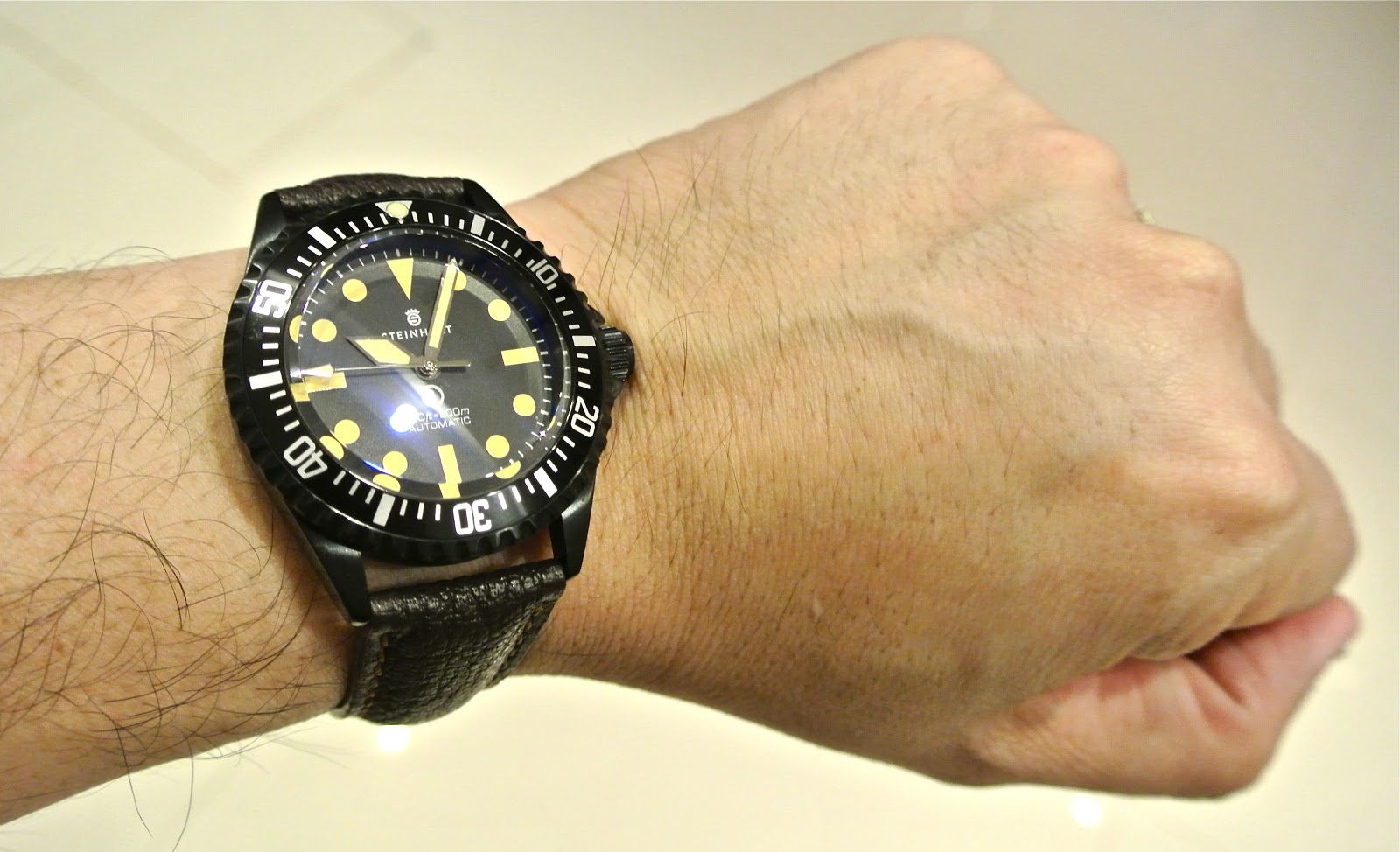
The OVM is indeed a handsome beast. The patina-ed looking orangey-yellow indices are eye-catching. the spearhead second hand and the well-proportioned hour and minute hands provide a beautiful balance on a simple, minimalist matte black dial. The uni-directional bezel completes a full revolution in 60 loud, crisp clicks. The bezel is easy to operate, thanks to the serrated circumference.

These twins are powered by ETA 2824-2 under the hood. However, the date function have been removed.


The OVM BO is similar to the OVM in every aspect except that it's DLC coated. The other difference I noted was the sound of the bezel clicks. The OVM BO's is not as crisp but has a kind of echo to it.


Both watches are fitted with slightly domed sapphire crystals that are slightly raised above the bezel. The thin profile of the OVM and OVM BO allows it to be tucked neatly under shirt cuffs, thus enhancing their versatility. However, like most DLC and PVD watches, the OVM BO is pretty much restricted to a casual function. The crowns are also signed with the Steinhart logo.


Both case backs are engraved with the standard Steinhart Ocean One Logo of a trident-wielding King Neptune riding a Seahorse-drawn chariot. The outline of the OVm feels a lot sharper than the OVM BO's.


the OVM comes standard with brushed stainless steel bracelet with polished sides and screwed-in links. The OVM BO comes fitted with DLC bracelet in the same configuration as the stainless steel variant. I've swopped the bracelet of the OVM BO with mocha calf straps as I do not want any battle scars on the original DLC bracelet.

the two watches are rather versatile. I've paired the OVM successfully with olive, brown and tan NATO straps. Successful pairings with the OVM BO include black, olive, black and mocha leather NATO's. Simple leather straps have proved to be equally competent with these watches.


On the wrist, both watches command attention but the OVM has more wrist presence, in my opinion.


These boys are no slouch in the dark either.


The OVM is a truly versatile watch that is at home under the shirt cuff as well as a weekend warrior. Its 42mm case size, coupled with the vintage look, commands wrist presence.


The OVM BO, on the other hand is not a desk-diver's best mate. It completes casual outfits better than shirts and cuffs. As with most black watches, it looks more diminutive than its stainless steel brother.

The OVM tends to get more wrist time then the OVM BO. It is not because I prefer one to the other. Preference does not have any influence as I like both watches. However, the OVM BO servers as another casual watch in my inventory. And there are only two weekends per week. However, my only consolation is that I was told the OVM BO is no longer in procudtion. I hope this is true.

One note to current and prospective owners, the screws on the brcelets tend to loosen over time and come off easily. Do apply some loctite to secure them.

Specifications:
Case diameter : 42mm.
Material : Stainless steel (OVM), stainless steel with DLC coating (OVM BO).
Movement : ETA 2824-2.
Lug size : 22mm.
Crystal : Domed sapphire.

Pros:
- Value for money.
- Versatility with strap options.
- Overall versatility (OVM).
- Commands wrist presence.
- Simple, eyetching design.
- Colour of markers.
- Balanced look.
- Just right case size.

Cons:
- Long wait for watch.
- DLC coating can chip off over time, particularly bracelet (OVM BO).
- Screws on links loosen over time.
- Constantly out of stock.
- No longer in production (OVM BO).
- MNot very versatile, limited to casual watch status (OVM BO).


Friday, 29 March 2013

Separated at Birth? - Laco Kiel and IWC Pilot Chronograph (ref: 3717)


Of all the watches I have in my tiny collection, there are a select few which I consider to be modern day classics. The IWC Pilot Chrono 3717 ranks among one of them. In fact, I've long considered it to be the be the Alpha among my little squad of elites. It boasts a perfect marriage between modern lines and classic curves. A perfect blend of the retro-vintage look with a modern touch that kind of ensure it's evergreen status. I've had it for about 4-odd years now and I don't seem to ever tire of it. Then came the usurper.

In a nutshell, the Laco Kiel is essentially a case of love at first sight. I caught sight of it when Anders of Gnomon was unboxing his latest delivery a couple of months back. the Kiel did not even had the opportunity to show off it's glorious curves. I snapped it up as soon as Anders took it out of the box. It did not even have the opportunity to live out part of its life in the display case.


How do these two stack up against each other? Before we move to that, let's take a look at their similarities.

For a start, these two look like twins separated at birth. Identical dial layout, day/ date window locations just to name a few. Both are pilot-themed chronos. They are powered by the efficient Valjoux 7750 work horse.


But the two are not exactly twins. Let's place the Laco Kiel under the microscope first.

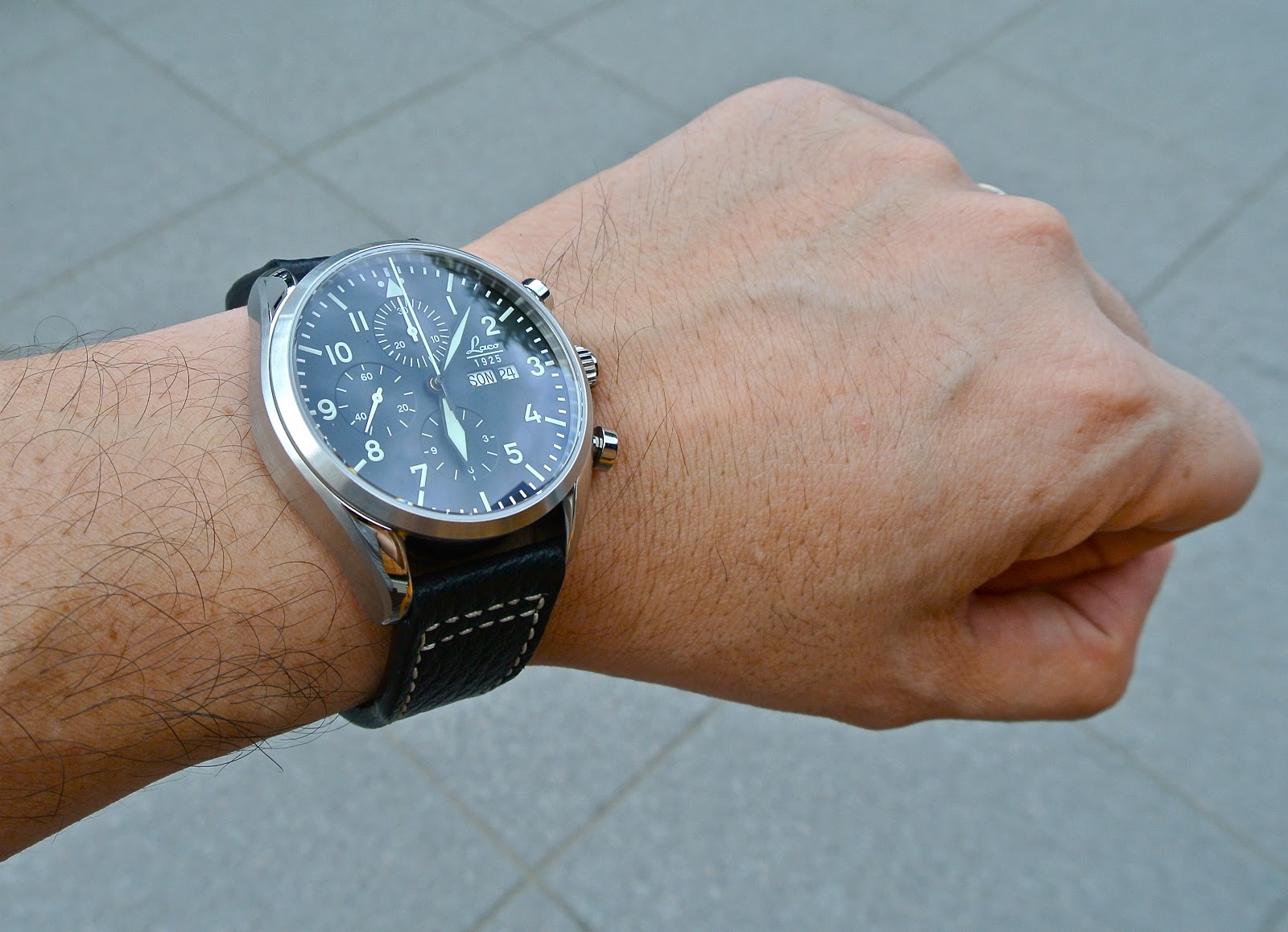
The Kiel is the larger of the two at 42mm. It is also chunkier than the 3717. In fact, it looks closer in thickness to the IWC Pilot Chrono Double chrono. The pushers are similar to those found on the IWC Portuguese. The crown is the standard push-in type. The day window shows the day in German. The case hosts a mix of both polished and brushed surfaces.

What I really like about the Kiel are the curves. Especially the lugs when viewed form the top. The curves blend in exceptionally well with the relatively huge case. The lugs extends naturally from the perfect circle of the case.

One peeve, however, is the minute hand. It's a tad too thin. Looks out of proportion to the fatter hour hand.

Thanks to the larger case, the dial does not look too cluttered or busy.


Now on to the 3717. This has a smaller case at 42mm. However, I fell that it looks smaller than a 42mm somehow. Pushers are the standard piston type. The 3717, however, comes with a scre-down crown. the dial looks somewhat busier than the Kiel although both adopted the same layout. This is due to the smaller case size. The lugs on the 3717 are straighter and protrude from the case. It does not look as seamless as the Kiel, in this sense.


The Kiel comes with a see-through case back. The lightly decorated rotor takes up most of the window.  The usual inscription borders the stainless steel of this rear window. However, I'm not a fan of exhibition case backs. Firstly, as I mentioned earlier, the rotor takes up much of the window. Secondly, this is just another Valjoux 7750. Unless it's an in-house movement or a 7750 with major modifications, I reckon this is unnecessary. Thirdly, a transparent case back would mean there is no anti-magnetic capabilities on this pilot watch, which, as far as I was told is one of the key elements in a pilots' watch.


Sticking to its formula of simplicity, the design team at Schaffhausen has chosen to keep the case back of the 3717 simple. Only the serial number and the unabbreviated brand name of its creator are etched on the brushed case back. Unlike the Kiel, the Valjoux 7750 in this piece is encapsulated within a Faraday cage constructed of soft iron. In average Joe speak, this means it's equipped with anti-magnetic capabilities.


AS you can see from the photo above, the lugs on the Kiel (right) are broader and curved sharper than the 3717's. Furthermore, the lug holes are set higher up the lug. This allows the watch to wrap around the wrist to ensure a more comfortable fit. This also means there is little overhang if worn on a smaller wrist. The 3717 have straighter lugs but this makes the watch seem slightly larger. If the lugs are surved too much, it might make the watch appear rather small.

My peeve with the 3717 lies in this area. Firstly, with the lug size at 21mm, this means one has limited strap options. Most would head back to Richemont and leave the service centre about SGD700 poorer. Yes, that's how much the original croc straps cost. Fortunately, I managed to fine replacement straps that fit perfectly (21mm). Although these are not croc straps, I reckon they match the watch better, actually.

The other peeve is the spring bar. The single collar stock spring bars are a nightmare to remove. They are set about a quarter of the way down the spring bar. This makes strap replacement a chore.


AS you can see from these shots above, the Kiel is perfectly shaped from the side. The curves looked naturally bent and are flawlessly and seamlessly constructed.


The 3717 looks slimmer in comparison. looks more like a dress watch in this sense.


However, I dislike the crown on both watches. Although well grooved, they are too tiny. It's very difficult for someone with stubby fingers and well bitten-off nails (like mine), to operate.


On the lume front, the Kiel beats the IWC hands down. They are as bright as charged neon tubes. Crisp and clear.


The lume on the 3717 is bright but pathetically spartan.


On the wrist, the Laco commands presence. Despite my 6 3/4" wrist, it looks masculine but not overly huge. the curved lugs contours to my wrist perfecely with zero overhang.


Due to it's smaller size, the 3717 looks like a perfect fit on my wrist as well.


I've done one test on the power reserve of these two watches. Interestingly, both surpassed the official 42 hours specified by their makers. The Laco Kiel ran out of gas after 51 hours. The 3717 ran on for a further 3 hours and rested after its 54-hour marathon. Not sure what modifications the folks at IWC did but it sure has a larger gas tank.


Both are drool-worthy timepieces. Each is a winner in its own right but the finishing on the 3717 is slightly better. The finishing on the Kiel is no slouch either. Though both are not perfect, they are noteworthy gems. If I had not bought the IWC much earlier, I'd have just settled for the Laco, which is priced almost 50% cheaper. At the price they are charging for the Kiel, it's a steal.


Specifications:

Laco Kiel -
Case diameter : 44mm.
Lug size : 22mm.
Crystal : Sapphire crystal.
Movement : Valjoux 7750.
Power reserve : +/- 42 hours (stated), 51 hours (actual).

IWC Pilot Chronograph (ref: 3717) -
Case diameter : 42mm.
Lug size : 21mm.
Crystal : Sapphire crystal.
Movement : Valjoux 7750.
Power reserve : +/- 42 hours (stated), 54 hours (actual).

Pros :
Laco Kiel -
+ Very well finished.
+ Large case (44mm).
+ Reliable movement.
+ Case and lug design (curved lugs).
+ Value for money (much cheaper than the IWC).
+ Nice lume.
+ German day window (unique).

IWC Pilot Chronoraph (ref: 3717) -
+ Very well finished.
+ Power reserve.
+ Reliable movement.
+ Simple, classic design.
+ Versatility ( can be used as a dress watch or as a sporty number).

Cons :
Laco Kiel -
- Small minute hand.
- no anti-magnetic capabilities.
- small crown.

IWC Pilot Chronograph (ref: 3717) -
- Bright but spartan lume.
- Pricey.
- Odd-sized lugs.
- Small crown.
- Difficult to remove spring bars.


-